Kites in Context
Exploring the social and economic role of ancient animal hunting traps in eastern Jordan
Project Abstract
Overview
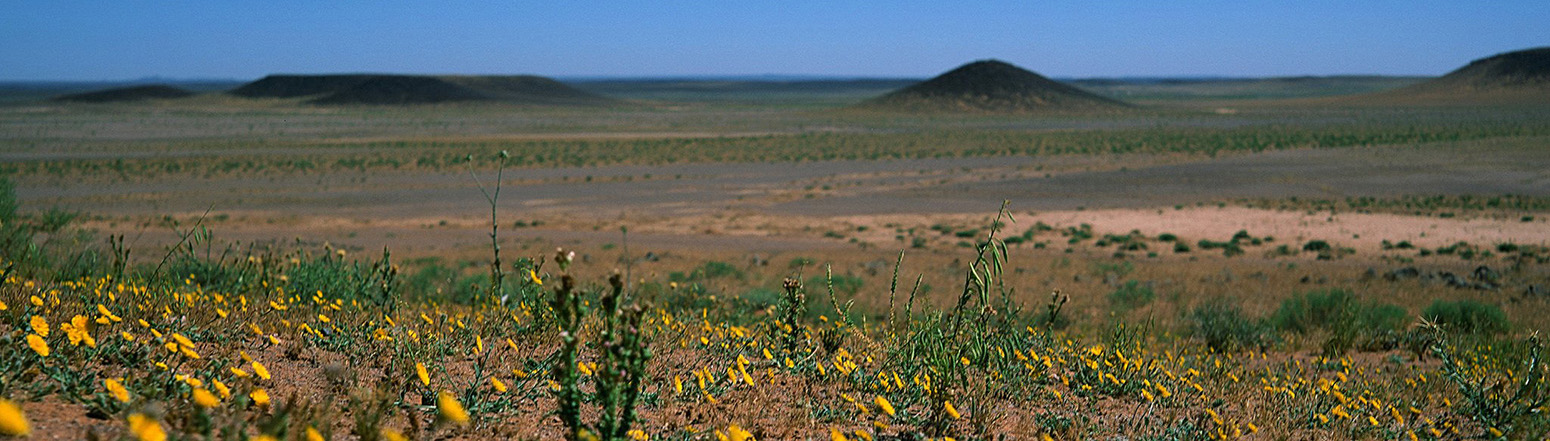
The Kites in Context project is investigating the social and economic role of ancient animal hunting traps in eastern Jordan known as “Desert Kites”. Located in the hyper-arid, basaltic “Black Desert” of eastern Jordan, these structures were built as mass-kill traps for gazelle during the later prehistory of the region. Each chain includes dozens to hundreds of individual traps, spanning tens of kilometers, linked by intricate wall networks that functioned to create one enormous system. These represent a remarkable ancient infrastructural investment that required significant organization of labor and the ability to generate subsistence surpluses in a marginal environment beyond the famous Fertile Crescent. This new study of desert kites, in context, focuses on the economy of this desert infrastructure and the social organization of large-scale prey-manipulation strategies, to offer new insight into subsistence adaptations beyond the agricultural zone. The results from this research have the potential to transform our knowledge of human responses and adaptations to arid environments in prehistory.
| Descriptive Attribute | Value(s) |
|---|---|
|
Creator
Vocabulary: DCMI Metadata Terms (Dublin Core Terms) |
|
Suggested Citation
Austin “Chad" Hill, Yorke M Rowan, Kathleen D Morrison. (2026) "Kites in Context". Released: In prep. Open Context. <https://opencontext.org/projects/aebeee67-b9d9-4920-b952-5483d41e83cd> DOI: https://doi.org/10.6078/M7GT5K9Z
Editorial Status
○○○○○Copyright License

To the extent to which copyright applies, this content
carries the above license. Follow the link to understand specific permissions
and requirements.
Required Attribution: Citation and reference of URIs (hyperlinks)