Western Argolid Regional Project
An interdisciplinary project to investigate all periods of human activity in the western Argolid; under the aegis of the Canadian Institute in Greece and the Hellenic Ministry of Culture.
Project Abstract
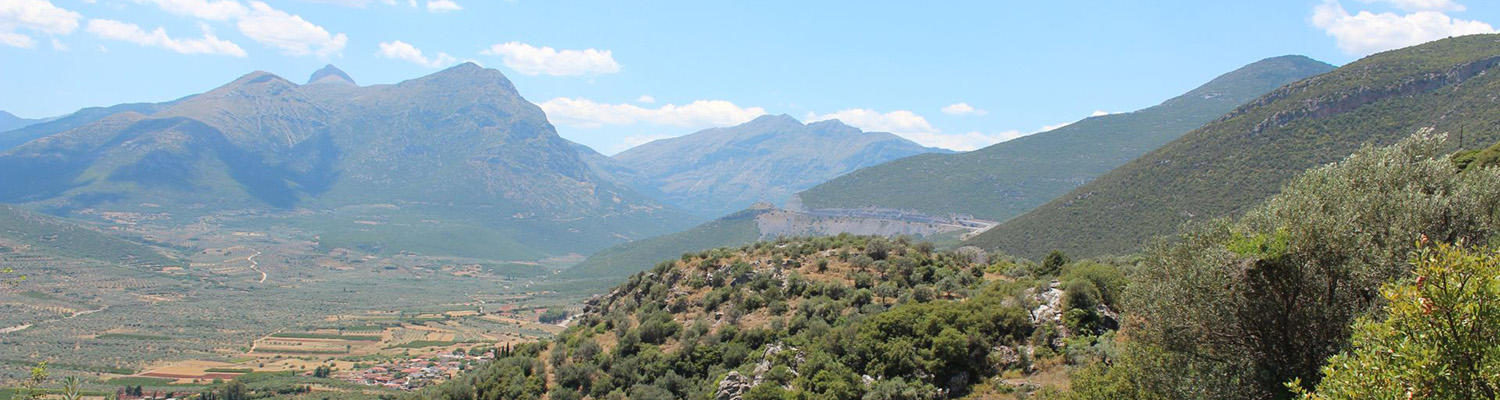
The Western Argolid Regional Project (WARP) is a diachronic archaeological survey of the upper Inachos river valley, in the region of the modern villages of Lyrkeia, Schinochori, and Sterna. The project’s overarching research goal is to understand the shifting relationship through time between the communities of the western Argolid and their position in the larger interregional networks of the northeastern Peloponnese and beyond.
From 2014-2016, WARP covered 18.33 square kilometers through methods that combine the high-intensity, “siteless” collection strategies of recent archaeological surveys in Greece (characterised by small survey units and near-total collection protocols) with the larger coverages typical of surveys in the “new wave” of the 1980s. Our survey units were small, averaging 0.25 hectares, on par with urban surveys elsewhere in the Mediterranean. Fieldwalkers were spaced at 10 meter intervals and covered a 2 m wide swath through each survey unit. Field teams recorded ancient and modern features in each survey unit, including current land use and vegetation cover, soil condition and color, and surface visibility. These data allow us to assess the relationship between modern use and artifact density across our survey area.
All artifacts observed by field teams were collected in toto, excepting tile, which was sampled (by collecting diagnostic pieces and distinct fabric types). Areas of interest were revisited and additional artifacts were collected. In total, nearly 70,000 artifacts have been collected and analyzed by a team of specialists. Each artifact has been described and categorized using the "chronotype system," used by a number of different survey projects in Greece and Cyprus, which assigns to each artifact a type that locates it within functional, chronological, and typological hierarchies.
These data will be especially useful to archaeologists and historians interested in human settlement and activity in the Mediterranean and Greece in particular. The study area is proximal to the city of Argos, an important center in virtually every period of Greek prehistory and history, but whose hinterland and relations to other centers is poorly understood. The western Argolid also played a crucial role as a corridor for land travel through the Peloponnese: numerous natural passes converge on our study area, linking it directly to several regions, some of which have been intensively surveyed. WARP is consequently in a position to make a substantial contribution to our understanding of the various overland routes and networks that connected the Argolid to the rest of the Peloponnese. This work not only expands our knowledge of one of the most important urban centers in southern Greece, but allow us to discuss the archaeological evidence for connectivity between cities through time, the material culture of communities situated at political margins, and practices of resistance and collaboration in the rugged hinterland of a politically-dominant Greek coastal zone.
Suggested Citation
William R. Caraher, Grace Erny, Rachel Fernandez, Joseph Frankl, Alyssa Friedman, Scott Gallimore, Melanie Godsey, Machal Gradoz, Heather Graybehl, Sarah James, Dimitri Nakassis, William Parkinson, Daniel Pullen, Guy Sanders, Stephanie Steinke, Samantha Walker. (2026) "Western Argolid Regional Project". Released: In prep. Open Context. <https://opencontext.org/projects/892c5794-4f2a-4c5c-8c75-d72193d20c86> DOI: https://doi.org/10.6078/M7JS9NH8
Editorial Status
○○○○○Copyright License

To the extent to which copyright applies, this content
carries the above license. Follow the link to understand specific permissions
and requirements.
Required Attribution: Citation and reference of URIs (hyperlinks)