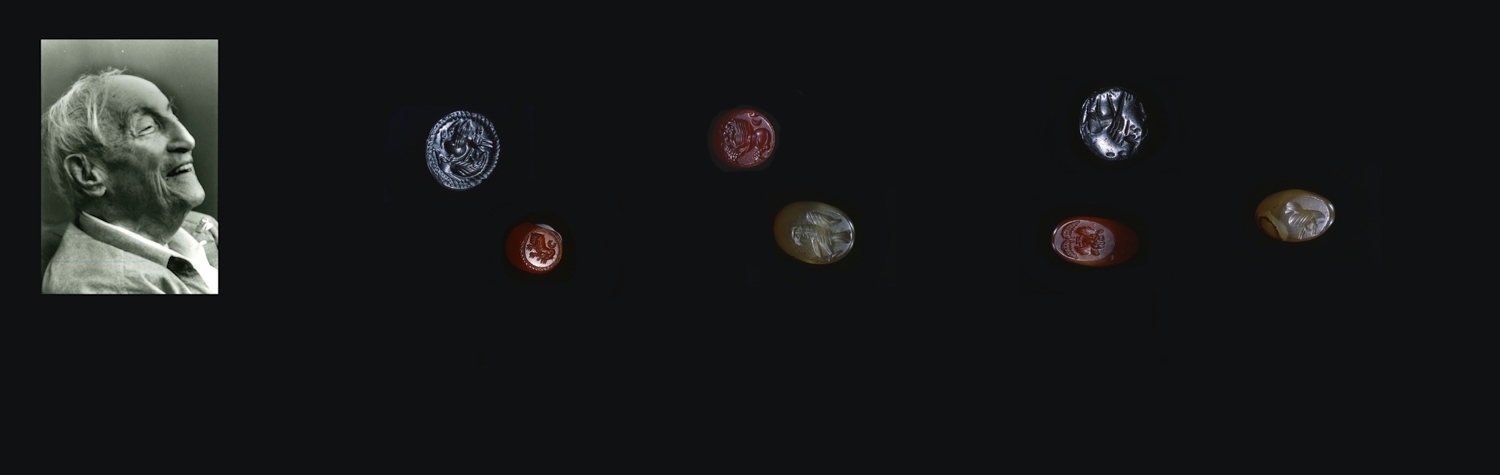
The Edward Gans Collection of Seals at UC Berkeley
A collection of seals at UC Berkeley specializing in Sasanian and Ancient Near Eastern seals with holdings from other cultures
Project Abstract
Overview
The Edward Gans Collection of Seals (EGC) at the University of California, Berkeley comprises 680 seals and seal-related objects as well as 111 modern impressions of seals not in the EGC (alongside modern impressions of all EGC seals). Seals in the EGC originate from a variety of geographic regions and time periods. The particular strength of the EGC lies in an extensive collection of Sasanian seals, which constitute over half of the entire collection. In addition to the Sasanian seals, the EGC holds large groups of seals of Ancient Near Eastern, Mesoamerican, and Minoan origin.
Nature of the Data
The Gans Collection project at OpenContext contains a variety of descriptive data on the EGC seals, including historical data such as culture, period, and date; as well as data about the seals’ materiality such as dimensions, weight, color, and wear; and descriptions of the seals’ content such as iconography and inscriptions. The database also provides information about the seals’ history of publication, archival documentation held by the collection, and occasional miscellaneous notes about particular seals. Also included are photographs of the seals.
History of the Study of the Edward Gans Collection
Edward Gans always intended the collection to serve as a resource for academic study. Seals in the EGC have been studied by various scholars since its inception, but the amount of study received by the different groups of seals has varied widely.
Sasanian seals in the Gans Collection have received the most attention, due in part to the predominance of such seals. Sasanian seals in the EGC were studied by Catherine Bullock-Demos for a B.A. thesis (Bullock 1994). The most extensive work on the Sasanian seals in the EGC occurred during the 1990s and early 2000s. A team led by Guitty Azarpay cataloged, photographed, and made impressions of the entire Sasanian holdings. Their efforts culminated in a searchable database created in FileMaker Pro 4.1. The Azarpay-led project database was published online through the Electronic Cultural Atlas Initiative (ECAI) at UC Berkeley in the early 2000s. As of 2025, the original database is inaccessible. The team also produced a report on the collection (Azarpay 2001). Inscriptions on the Sasanian seals were read by Philippe Gignoux. His results were published by the Azarpay project and can be found in the ECAI publication (Azarpay 2001, pp. 21–23).
Mesopotamian seals in the EGC were first studied by Near Eastern art historian Edith Porada in the 1960s. Porada produced a typescript catalog, a copy of which is held in the EGC. Porada described and dated the seals. Ancient Near Eastern seals in the EGC are described by a handwritten motif card index kept in the EGC. Many of Porada’s notes appear also as typewritten cards in card catalogs in EGC holdings.
Mesoamerican seals in the EGC were cataloged by Wolfgang Heimpel. Heimpel is a Sumerianist by profession and does not have a background in Mesoamerican glyptics. The seals have not been studied in depth by any scholars specializing in the relevant cultures. During a brief visit in 2023, Rosemary Joyce indicated that several of the Mesoamerican objects in the EGC are modern forgeries. She also corrected previous non-specialist scholars’ assumptions that the objects are all seals: in fact, many of the Mesoamerican objects are stamps intended for applying ink to skin rather than seals that make impressions in a soft matrix. The Mesoamerican objects in the EGC could greatly benefit from more extensive study by scholars with the relevant specialities.
Potential Applications of the Data
The Edward Gans Collection should serve as a useful set of objects for the study of sigillography. The variety of seals in the collection encourages comparative work. In terms of specific cultures, the collection will be most helpful for scholars studying Sasanian and Mesopotamian seals and glyptics.
Support
Bita Daryabari Presidential Chair of Iranian Studies at UC Berkeley.
Related Publications
Azarpay, Guitty (ed.). 2001. Sasanian Seals from the Collection of the late Edward Gans at the University of California, Berkeley, with contributions from Catherine Demos, Edward Gans, Lydia Gans, Wolfgang Heimpel, Anne Draffkorn Kilmer, Sanjyot Mehendale, Jeanette Zerneke. Electronic Cultural Atlas Initiative Publication, UC Berkeley. https://escholarship.org/uc/item/8ns6650c
Bullock, Catherine. 1994. Sasanian Sealstones. Unpublished B.A. thesis, Department of Middle Eastern Languages & Cultures, University of California, Berkeley. https://escholarship.org/uc/item/9p46b7rg
Gans, Edward. 1987. Berlin Banker to California Numismatist, 1887–1987 . Berkeley, Calif.: University of California. https://archive.org/details/berlinbankercali00gansrich
Ziegler, Alice H. 2025. “Five Sasanian Seals in the Edward Gans Collection at the University of California, Berkeley.” Sēnmurw: Journal of Iranian Studies 4: 119–38.
Ziegler, Alice H. 2025. “A Brief Handbook to the Edward Gans Collection of Seals.” Department of Middle Eastern Languages & Cultures, University of California, Berkeley. https://escholarship.org/uc/item/14q686n6
Current Disposition of the Physical Collection
The Edward Gans Collection of Seals is currently housed at the UC Berkeley campus. Please contact Adam Benkato for inquiries regarding site visits.
| Descriptive Attribute | Value(s) |
|---|---|
|
Creator
Vocabulary: DCMI Metadata Terms (Dublin Core Terms) |
|
|
Subject
Vocabulary: DCMI Metadata Terms (Dublin Core Terms) |
|
|
Spatial Coverage
Vocabulary: DCMI Metadata Terms (Dublin Core Terms) |
Iran
Vocabulary: GeoNames Open Context References: Iran |
|
Temporal Coverage
Vocabulary: DCMI Metadata Terms (Dublin Core Terms) |
Sasanian
Vocabulary: EAMENA Database Periods Open Context References: Sasanian |
Suggested Citation
Adam Benkato, Sanjyot Mehendale, Benjamin Porter, Alice Ziegler. (2026) "The Edward Gans Collection of Seals at UC Berkeley". Released: 2026-05-11. Open Context. <https://opencontext.org/projects/581049dc-510f-497d-bab4-7c74c4e4c5bd> DOI: https://doi.org/10.6078/M7KP809M
Editorial Status
●●●○○Copyright License

To the extent to which copyright applies, this content
carries the above license. Follow the link to understand specific permissions
and requirements.
Required Attribution: Citation and reference of URIs (hyperlinks)