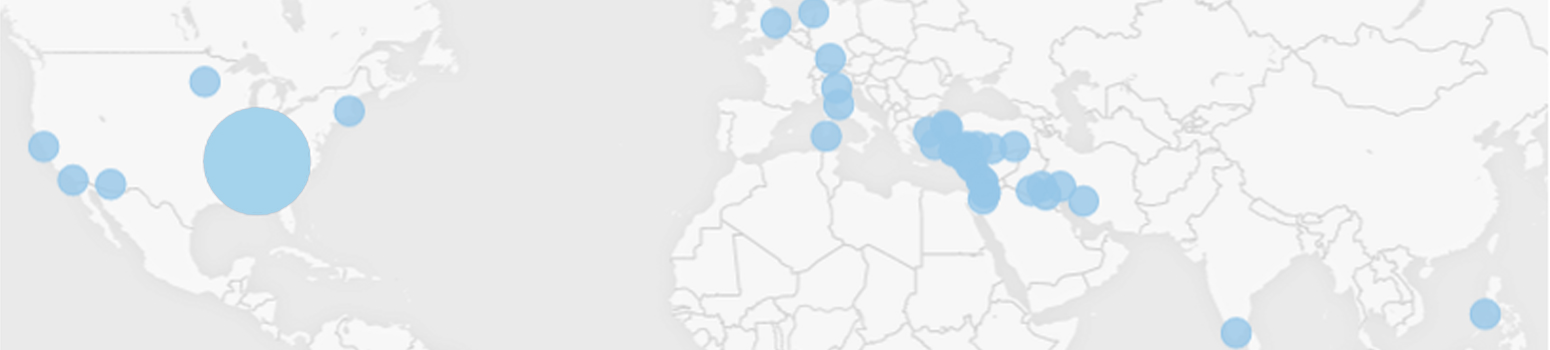
Interanalyst Variation Assessment for Faunal Assemblages at Domuztepe
Data and Paradata for the Operation III Assemblage
Project Abstract
Overview
The goal of this study was to determine how two analysts varied in their analyses of one assemblage. Our analysis and its implication are detailed in Lau and Kansa (2018). To complete this study both analysts independently examined and recorded the full assemblage with access to the same reference collection and reference materials and under the same laboratory conditions. We then compared our results.
Through these analyses we determined that our identifications are generally in agreement, with the following caveats:
- One observer primarily lumped specimens identified to size-class only as either medium mammal or large mammal. The other observer more frequently used the categories medium mammal, medium-large mammal, and large mammal. This means the size-class data is not comparable, and must be used with trepidation.
- We found frequent discrepancies with identifications of fragmentary horn cores. Unless the horn core fragment is large (e.g. contain a full cross-section of the horn) fragments from this dataset should not be attributed to a taxonomic class of greater specificity than family.
These data are relevant for any analyst who plans to combine data from Lau's and Kansa's independent analyses of different sub-sets of the Domuztepe faunal Assemblage (e.g. Kansa 2010; Lau 2018a).
Description of Assemblage
This faunal assemblage is from the late Neolithic site of Domuztepe (c. 6000 - 5450 BCE), located in southeastern Turkey. This assemblage was excavated during the 1990s and the collection exported to the United States for analysis. The assemblage is presently located at the University of California, Los Angeles.
The assemblage described in these data records is a subsample of the complete assemblage from Operation III at Domuztepe. Given the goals of this study, the dataset records contains two spreadsheets describing the same specimens, which can be cross-referenced by each individual bone number. The rest of the Operation III faunal assemblage records can be viewed on the Domuztepe Animal Bones data publication by Sarah Whitcher Kansa.
Recovery Methods
This assemblage is a handpicked assemblage. During excavation, considerable portions of the contexts were dry and/or wet screened, but all resultant bone material from heavy fraction was kept in Turkey at the Kahramanmaraş Museum, and thus were inaccessible for this study.
All specimens were cleaned with water and a toothbrush and air-dried, not in direct sunlight. As the specimens were heavily accreted, in some cases a dental pick was used to carefully remove accretions obscuring important aspects of the bone or tooth surface.
Identification Methodology and Recording
Each specimen was individually observed and described in an excel database initially developed by Sarah Whitcher Kansa. Measurements were recorded following standard practices following von Den Driesch (1976), with some additional measurements developed by Whitcher (2000). Toothwear was recorded in reference to systems designed by Payne (1973) for sheep and goat and Grant (1982) for cattle and pigs. The dataset file contains one spreadsheet page labeled "Database Key" that describes the meaning of each field and one spreadsheet page labeled "Measurement Key," which describes which field corresponds to which measurement for each element.
All analyses for this dataset occurred at the University of California, Los Angeles's Cotsen Institute of Archaeology. Analysts had access to the comparative collections in the Cotsen’s Zooarchaeology Laboratory. Additionally, analysts had access to a number of guides (Boessneck 1969; Helmer and Rocheteau 1994; Hillson 2005; Pales 1971; Prummel 1988; Prummel and Frisch 1986; Schmid 1972; Walker 1985; Zeder and Lapham 2010) and 3-D images (gazelle, beaver, and horse from the Max Planck Institute for Evolutionary Anthropology, see Niven et al. 2009).
We chose not to assign ribs and vertebrae (with the exception of the atlas, axis, and sacrum) to any taxonomic group more specific than taxonomic class and size class. Specimens that were too fragmentary to be assigned to a specific species were assigned to whatever taxonomic category the analyst felt confident about (e.g. for some, "ungulate", for others, "medium mammal).
This assemblage, like many contemporaneous assemblages from the Near East, includes a large number of specimens that we attribute to sheep, goat, or sheep/goat. There is considerable debate as to what criteria is valid for differentiating zooarchaeological specimens between sheep and goat. We have chosen to use the following criteria:
|
Element |
Attribute(s) |
Citation(s) |
|---|---|---|
|
Cranium |
|
Boessneck 1969; Prummel and Frisch 1986 |
|
Atlas |
|
Boessneck 1969 |
|
Axis |
|
Boessneck 1969 |
|
Scapula |
|
Boessneck 1969; Prummel and Frisch 1986; |
|
Humerus |
|
Boessneck 1969; Prummel and Frisch 1986; Zeder and Lapham 2010 |
|
Radius |
|
Boessneck 1969; Prummel and Frisch 1986; Zeder and Lapham 2010 |
|
Ulna |
|
Boessneck 1969; Prummel and Frisch 1986 |
|
Metacarpal |
|
Boessneck 1969; Prummel and Frisch 1986; Zeder and Lapham 2010 |
|
Femur |
|
Boessneck 1969; Prummel and Frisch 1986 |
|
Tibia |
|
Prummel and Frisch 1986; Zeder and Lapham 2010 |
|
Metatarsal |
|
Boessneck 1969; Prummel and Frisch 1986; Zeder and Lapham 2010 |
|
Calcaneus |
|
Boessneck 1969; Prummel and Frisch 1986; Zeder and Lapham 2010 |
|
Astragalus |
|
Boessneck 1969; Prummel and Frisch 1986; Zeder and Lapham 2010 |
|
Phalanx 1 |
|
Boessneck 1969; Zeder and Lapham 2010 |
|
Phalanx 2 |
|
Boessneck 1969; Zeder and Lapham 2010 |
|
Phalanx 3 |
|
Boessneck 1969 |
Acknowledgements
This research was supported by the National Science Foundation (#BCS-1419298 with Elizabeth Carter). Our thanks go to the General Directorate of Cultural Heritage and Museums in Ankara and Ahmet Denizhanoğulları, Director of the Kahramanmaraş Museum for their assistance. We would also like to thank Dr. Elizabeth Carter and Dr. Stuart Campbell for access to this collection and Dr. Thomas Wake, who provided access to comparative materials from the UCLA, Cotsen Institute of Archaeology Zooarchaeology Laboratory.
References
Boessneck, J.
Grant, Annie
Helmer, D. and Rocheteau, M.
Hillson, S.
Kansa, S. W.
Lau, Hannah
Lau, H. and Kansa, S. W.
Pales, L. and Lambert, C.
Payne, S.
Prummel, W.
Prummel, W. and Frisch, H. J.
Schmid, E.
von den Driesch, Angela
Walker, R.
Whitcher, Sarah
Zeder, M. A., and Lapham, H.
| Descriptive Attribute | Value(s) |
|---|---|
|
Creator
Vocabulary: DCMI Metadata Terms (Dublin Core Terms) |
|
Suggested Citation
Hannah Lau, Sarah Whitcher Kansa. (2026) "Interanalyst Variation Assessment for Faunal Assemblages at Domuztepe". Released: In prep. Open Context. <https://opencontext.org/projects/94247f2f-f4f7-4caa-b022-556e440c23d8> DOI: https://doi.org/10.6078/M7XK8CM8
Editorial Status
●●●○○Copyright License

To the extent to which copyright applies, this content
carries the above license. Follow the link to understand specific permissions
and requirements.
Required Attribution: Citation and reference of URIs (hyperlinks)