Čḯxʷicən Charcoal
Taxonomic identification of archaeological charcoal from Čḯxwicən for the purpose of AMS sample recommendation
Project Abstract
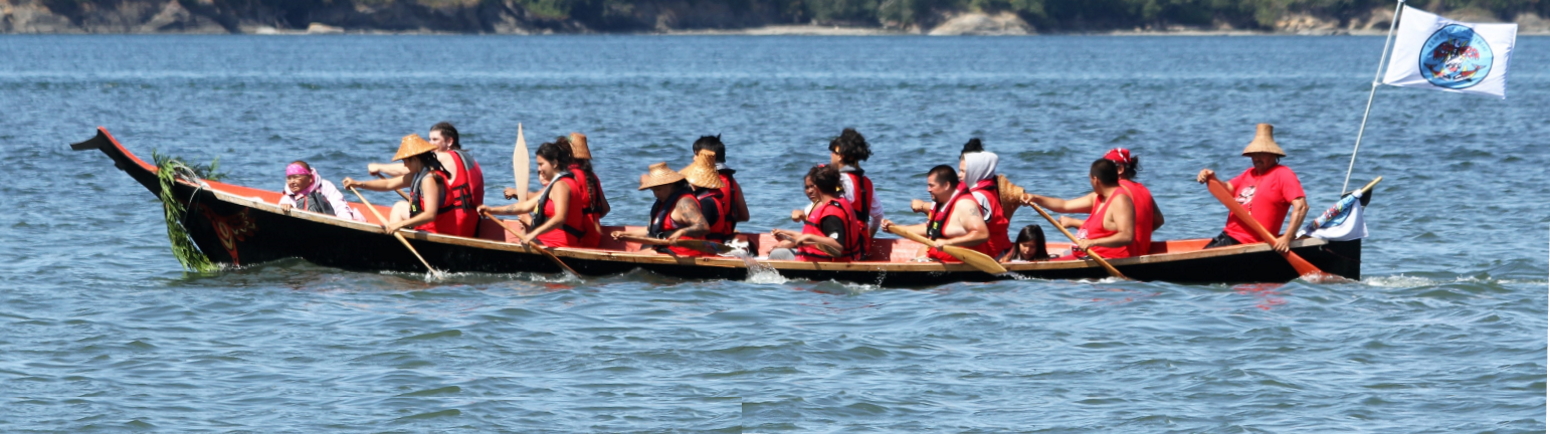
Banner photo credit: Lower Elwha Klallam Tribe on Canoe Journey, 2019, photo used with permission by Keri Ellis and LEKT
Overview
The Čḯxʷicən archaeological site (45CA523) is a Lower Elwha Klallam village site unearthed in 2003 in what is now Port Angeles, Washington. This large, coastal site is situated east of the mouth of the Elwha River on the shores of the Strait of Juan de Fuca. Following inadvertent discovery by Washington Department of Transportation construction activities, the ensuing archaeological investigations recorded cultural strata containing over 600 features such as hearths, post-molds, structural wood, gravel features, pits, shell lenses, and living surfaces, as well as human remains and bone and lithic artifacts. These elements, along with radiocarbon ages, suggest that Čḯx w icən was a large, ancestral village occupied for roughly 2,700 years. From 2012 to 2015, Salix Archaeological Services (SALIX) was contracted by Dr. Virginia Butler (Portland State University), Dr. Sarah Campbell (Western Washington University), and Dr. Sarah Sterling (Portland State University) to analyze charred wood, or charcoal, recovered from Čḯxʷicən. SALIX was tasked with providing taxonomic identifications of charcoal and selecting appropriate fragments for Accelerator Mass Spectrometry (AMS) dating. This data set and the associated PDF report describes the methods employed by this analysis, provides the taxonomic identifications, and assesses woody fuel use at Čḯxʷicən.
The methods described in the attached report support the stated goal of the charcoal identification, which was to select (preferably short-lived) samples for radiometric dating. Project leaders designed and executed an extensive AMS dating program to decipher the vast palimpsest of cultural and natural deposits at Čḯxʷicən and to understand the processes that created them. As such, this analysis was not designed as a comprehensive fuel analysis, nor was it part of a greater paleoethnobotanical investigation to study plant use at Čḯxʷicən. The greater radiocarbon sample selection goal guided decisions made in the level of taxonomic identification achieved, particularly when coniferous fragments were encountered that could exacerbate the "old wood" problem, as discussed in the following sections. Caveats aside, this analysis resulted in a large body of data that is valuable in its own right and, as of this writing, it is one of the only examinations of plant material from Čḯxʷicən.
See the attached report for detailed methods and analytical results. The Čḯxʷicən Charcoal Project is part of a larger zooarchaeological-geoarchaeological project, The Čḯxʷicən Project.
You may dynamically explore the data by clicking on "Data Records" at the right side of the screen or download a static CSV file of all records in the Čḯxʷicən Charcoal dataset.
Support
Funding for the Čḯxʷicən project came largely from the National Science Foundation [grant numbers 1219468, 1353610, and 1663789].
| Descriptive Attribute | Value(s) |
|---|---|
|
Contributor
Vocabulary: DCMI Metadata Terms (Dublin Core Terms) |
Jennie Shaw
Vocabulary: The Čḯxʷicən Project |
|
Subject
Vocabulary: DCMI Metadata Terms (Dublin Core Terms) |
|
|
Creator
Vocabulary: DCMI Metadata Terms (Dublin Core Terms) |
|

Suggested Citation
Jennie Shaw. (2018) "Čḯxʷicən Charcoal". In The Čḯxʷicən Project. Virginia L Butler, Kristine M Bovy, Sarah K Campbell, Michael A Etnier, Sarah L Sterling (Ed). Released: 2018-12-01. Open Context. <https://opencontext.org/projects/5351bac5-0543-4f7c-b484-913f6ba1610d> DOI: https://doi.org/10.6078/M76Q1V97
Editorial Status
●●●○○Part of Project

Copyright License

To the extent to which copyright applies, this content
carries the above license. Follow the link to understand specific permissions
and requirements.
Required Attribution: Citation and reference of URIs (hyperlinks)