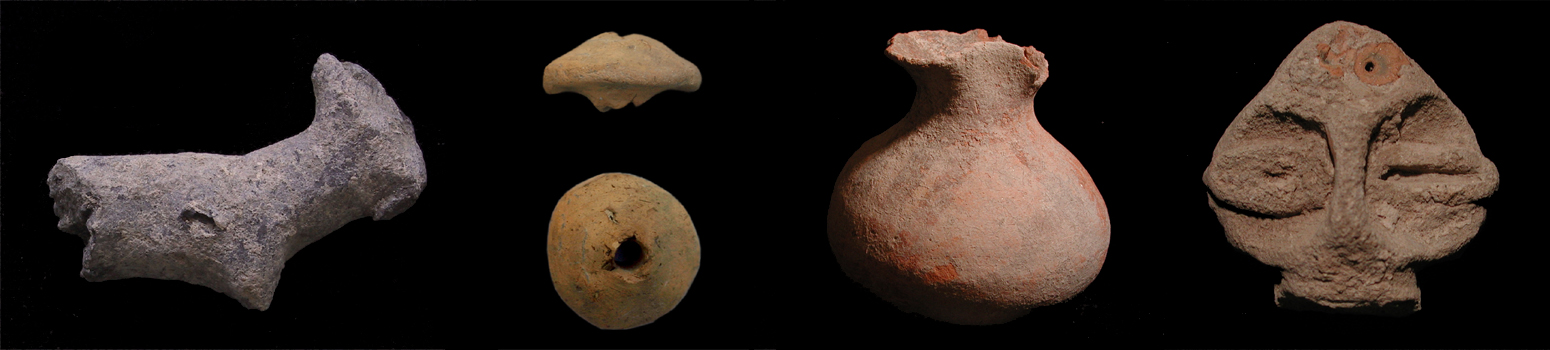
| Descriptive Attribute | Value(s) |
|---|---|
| Designator | Floor/Surface |
| General remarks | It is the contution of the locias 4015, 4013, 4009 and 4026. Their structure are same, actually they are on each others top, as surface floor. |
| Strat below | 4015 |
| Strat is cut by | 4028 |
| Strat equals | 4032, 4030 |
| Strat remarks | It is smooth, and the rocks are symetrical. |
| Top depth center | 590.65 |
| Bottom depth center | 590.64 |
| Dimension length | 3.5 |
| Dimension width | 1.05 |
| Start date | 2001-07-25 |
| End date | 2001-07-29 |
| Color | 7.5YR 5/4 brown |
| Texture | silt |
| Composition | fine |
| Tentative Date | Middle Bronze Age |
| Has note | Contexts excavated in trenches were recorded using the "locus system." A locus is any discrete three-dimensional entity excavated in a trench. The key to the locus system is the recognition that a locus is any one thing. Differences in soil composition or texture are therefore as important as, for example, the difference between a pit and a wall. If two entities were distinct, they were considered separate loci and were therefore assigned separate locus numbers. It should also be noted that every context excavated in a trench was given a locus number and thus the trench itself is made up completely of excavated loci. |


Suggested Citation
Sibel Torpil. (2012) "Locus 4025 from Asia/Turkey/Kenan Tepe/Area D/Trench 4". In Kenan Tepe. Bradley Parker, Peter Cobb (Ed). Released: 2012-03-28. Open Context. <https://opencontext.org/subjects/24053f9d-8a40-4765-28db-0c96a5fcb2c2> ARK (Archive): https://n2t.net/ark:/28722/k2qz27c7r
Editorial Status
●●●●○Part of Project

Copyright License

To the extent to which copyright applies, this content
carries the above license. Follow the link to understand specific permissions
and requirements.
Required Attribution: Citation and reference of URIs (hyperlinks)